Even advanced students benefit from introduction lessons before engaging with an unfamiliar text. The fifteen Frankenstein pre-reading activities below give teachers a range of options for providing background, activating prior knowledge, and setting a purpose for reading before students open the novel.
Which literary elements and themes are essential to your exploration of Frankenstein? Shelley’s use of allusions? A particular theme? The Romantic movement? The crafting of structural effects like mystery, tension, suspense, and surprise? Figurative language and imagery? Choose the activities that match your unit goals.
1. Anticipation Guide: Introducing Key Themes
7. The Incomparable Mary Shelley
9. Effects of Structure: Foreshadowing
11. Front-Loading Frankenstein‘s Allusions
14. Are Monsters Made or Born?
15. Pre-Viewing the Final Task
1. Anticipation Guide: Introducing Key Themes

A practical way to get students considering theme subjects before they read is by asking them to respond to a list of debatable statements. The Frankenstein anticipation guide covers the novel’s central concerns and generates discussion that pays dividends throughout the unit.
Discussion topics: Science fiction, ambition, nature vs. nurture, the value of science and industry, emotions, appearances, spending time in nature, revenge, parenthood, narrative effects, and preconceived notions about the monster.
Lesson steps:
- Complete the anticipation guide individually.
- Share and discuss responses in a small group.
- Choose one discussion to share with the class.
The discussions generated by this lesson are often the richest of the unit, partly because students are invested in their own positions before the novel challenges them.
Frankenstein Anticipation Guide (FREE)
2. Getting Romantic with Art


DOWNLOAD OR PRINT (PDF)
Standard: SL4 Presentation of Knowledge and Ideas
This activity uses fine art to get students acquainted with Romanticism before they encounter it in the text. After a brief introduction to the movement and its ideals, student groups each select one famous Romantic painting to analyze and present to the class.
Works in the lesson include paintings by: Caspar David Friedrich, Eugène Delacroix, Henry Fuseli, Francisco de Goya, J.M.W. Turner, Théodore Géricault, Thomas Cole, and Henry Wallis.
Lesson steps:
- Choose one piece of art to analyze.
- Write your analysis: purpose and audience, subject, emphasis, tone, feeling or theme, and style.
- Research the work if time allows.
- Present your findings. Connect the art to the ideas of Romanticism.
The goal is for students to understand that Frankenstein is not a horror novel in the popular sense. It is a product of a specific literary and philosophical moment, and the visual art of the period makes that moment concrete before students encounter it in Shelley’s prose.
Helpful clip: “Introduction to the Romantic Movement” (10 minutes) by Martin Travasse
3. Key Excerpts Preview
“I abhorred the face of man. Oh, not abhorred! They were my brethren, my fellow beings, and I felt attracted even to the most repulsive among them, as to the creature of an angelic nature and celestial mechanism. But I felt that I had no right to share their intercourse… How they would each and all, abhor me and hunt me from the world did they know my unhallowed acts and the crimes which had their source in me!”
Standard: RL1 Key Ideas and Details (textual evidence)
Before students read the novel, give each group one key excerpt from the text and ask them to predict, theorize, and analyze. The exercise builds anticipation, activates literary analysis skills, and gives students a first look at Shelley’s style.
Discussion questions for each excerpt:
- Which character or narrator might be speaking?
- What might be the context of this quote?
- What does this excerpt imply about the events of the novel?
- What are the key literary elements at work (imagery, theme, symbol, characterization, word choice, tone)?
Additional excerpts to use:
“The wounded deer dragging its fainting limbs to some untrodden brake, there to gaze upon the arrow which had pierced it, and to die, was but a type of me.”
“…a few shattered pines were scattered around; and the solemn silence of this glorious presence-chamber of imperial nature was broken only by the brawling waves or the fall of some vast fragment, the thunder sound of the avalanche…”
“‘Like Adam, I was apparently united by no link to any other being in existence; but his state was far different from mine in every other respect. He had come forth from the hand of God a perfect creature, happy and prosperous, guarded by the especial care of his Creator… Many times I considered Satan as the fitter emblem of my condition….'”
“‘…a fierce wind arose from the woods and quickly dispersed the clouds that had loitered in the heavens; the blast tore along like a mighty avalanche and produced a kind of insanity in my spirits that burst all bounds of reason…'”
“He was alive to every new scene, joyful when he saw the beauties of the setting sun, and more happy when he beheld it rise and recommence a new day. He pointed out to me the shifting colors of the landscape and the appearances of the sky. ‘This is what it is to live,’ he cried…”
“‘Slave, I before reasoned with you, but you have proved yourself unworthy of my condescension. Remember that I have power; you believe yourself miserable, but I can make you so wretched that the light of day will be hateful to you.'”
“‘And now, behold, with the first imagination of danger, or, if you will, the first mighty and terrific trial of your courage, you shrink away and are content to be handed down as men who had not strength enough to endure… Oh! Be men, or be more than men…'”
4. Giving Sci-Fi a Try
Standard: RL3 Key Ideas and Details (interacting elements)
This activity is both receptive and creative. Students think about the characteristics of modern science fiction by reading and analyzing a short story, then get creative in conceiving their own original sci-fi premise.
Group task:
- Read “Super-Toys Last All Summer Long” (8 pages) by Brian Aldiss. The story works particularly well because it poses questions about humanity and parental responsibility that connect directly to Frankenstein.
- Discuss the story and complete the analysis page.
- Share your response to the final section with the class.
Creative writing task: Students brainstorm a list of ideas for an original sci-fi story, then plan a narrative with a sci-fi premise, literary elements, and a clear theme.
The key takeaway for students: modern science fiction moralizes or speculates about current scientific developments. It does not just entertain. It asks what could go wrong, and it warns. Students who understand this before they begin reading will approach Frankenstein as the genre-defining work it is.
For teachers who prefer a nonfiction approach, students can argue the value of science fiction as a genre using articles from Galactic Brain, New America Foundation, and WIRED.
5. One-Scene Themes: Ambition

Standards: W3 Narrative Writing, SL1A-B Comprehension and Collaboration
Ambition is one of Frankenstein‘s most important theme subjects. In this activity, each group writes and performs a one-scene play focused on the theme of personal ambition. The take on ambition, positive or negative, is up to the group.
Individual stage:
- What is your view on the positives and negatives of personal ambition?
- Brainstorm three ideas that could form a scene on this theme.
- Choose your best idea and identify the setting, characters, plot and conflict, and theme.
Group stage:
- Set rules for decision making and record them. How will you share ideas? How will roles be determined? How will disagreements be settled fairly?
- Share proposals.
- Plan the final idea. Make sure the theme is clear and develops through character motivation, setting, plot, conflict, or a symbolic element.
- Assign roles and compose the script.
The ambition theme connects directly to Victor Frankenstein’s arc. Students who have already thought carefully about what drives people to pursue greatness at any cost will have richer analytical discussions when they encounter it in the novel.
6. The Frame of the Tale
Standard: RL5 Craft and Structure (narrative structure)
Frankenstein uses one of the most sophisticated frame structures in English literature. This activity prepares students to recognize and analyze it before they encounter it in the text.
Into: A frame tale is when the central story or stories are told within an outer story that sets the stage. In The Canterbury Tales, a group of travelers holds a story contest; the contest creates the frame for the other stories.
Students identify a frame tale from their own experience — a film, novel, or episode that opens with one story setting up another — and briefly explain how the frame works and why the author used it.
Through: Frankenstein has frames within the frame. Captain Walton’s story frames the doctor’s story. The doctor’s story frames the creature’s story. The creature frames the story of the De Lacey family. Rather than a box full of smaller boxes, think of nesting dolls.
Students read “The Celebrated Jumping Frog of Calaveras County” by Mark Twain as a classroom example of the framing device. In Twain’s case, the frustration of the narrator at being a captive audience is the frame. The outer story, not the inner one, conveys the theme. Students analyze how Twain uses the device, then discuss how Shelley’s approach differs.
Beyond: Students plan an original narrative set within an outer story and explain what effect the frame will have on the telling.
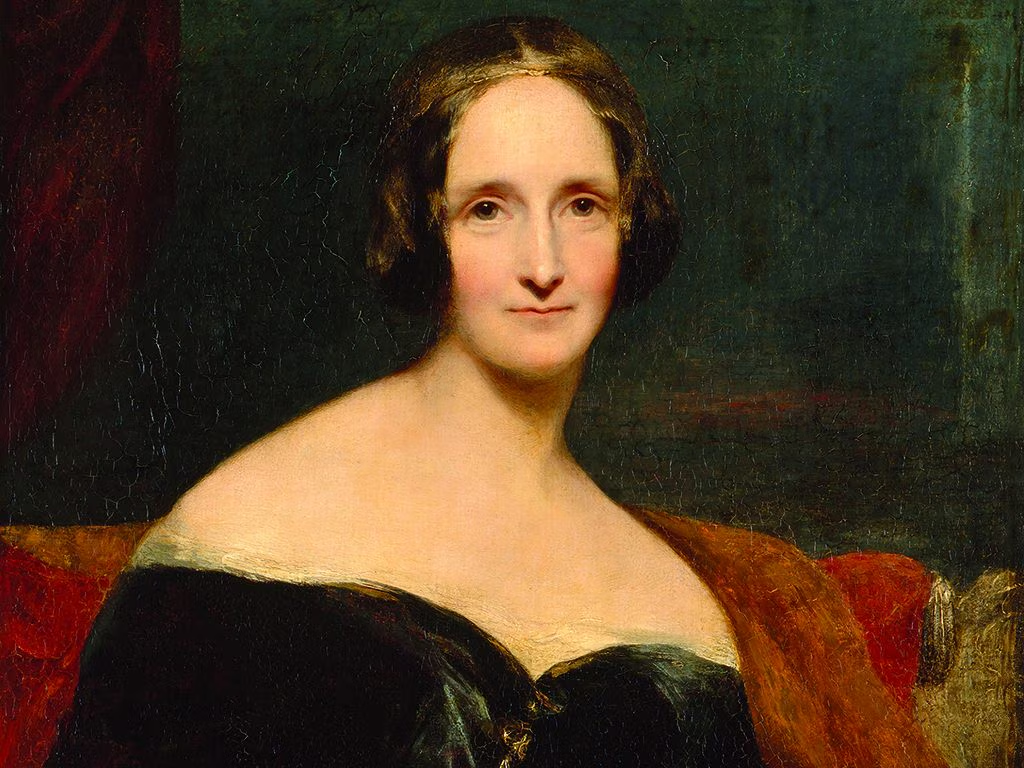
7. The Incomparable Mary Shelley
Standard: RL6 Craft and Structure (context and point of view)
Knowing who Mary Shelley was makes Frankenstein a richer and more surprising read. She was nineteen when she began writing it, had already lost a child, lived outside the bounds of conventional society, and was the daughter of two of the most radical thinkers of her age. The novel reflects all of that.
Assign one or more of the following nonfiction readings to help students contextualize the author and the historical moment:
- “How a Teenage Girl Became the Mother of Horror” from National Geographic
- “Who was Mary Shelley and what inspired Frankenstein?” from The Independent
- “How Romanticism rebelled against cold-hearted rationality” from The Conversation
8. Romantic Poetry Open-Mic

Standard: W10 Range of Writing
Romanticism is not just supernatural horrors and emotionally tortured heroes. It is also uplifting poetry, and there are sensibilities shared by Romantic novelists and Romantic poets that students will recognize in Frankenstein.
Students write their own example of Romantic poetry, then share it in a class open-mic format. The goal is to imitate the subjects, moods, and style of the movement — not to produce a polished literary masterpiece.
Five Romantic poems worth sharing before students write:
- “I Wandered Lonely as a Cloud” by William Wordsworth
- “Sonnet on Being Cautioned Against Walking on a Headland” by Charlotte Smith
- “Darkness” by Lord Byron
- “Oh, Come to Me in Dreams, My Love” by Mary Shelley
- “Ozymandias” by Percy Shelley
What matters to a Romantic poet: sublime experiences, emotion, imagination (horror, fantasy, dreams), the rejection of dehumanizing industry, nature, individuality, melancholy, and ornate language.
Pre-writing: Students identify a subject, speaker and point of view, main theme or feeling, and the Romanticism elements and poetry techniques they plan to emphasize: structure, imagery, figurative language, connotations, sound devices, tone, mood.
9. Effects of Structure: Foreshadowing

Standard: RL5 Craft and Structure (effects of structure)
Shelley uses foreshadowing from the first pages of Frankenstein. This activity prepares students to recognize and analyze it before they encounter it in the novel, using a short story as the practice text.
Types of foreshadowing:
- Chekhov’s gun / concrete foreshadowing: The author introduces an object whose significance is not yet clear. The reader notes it and waits. Its importance will be revealed later in the story.
- Word choice: The author clues the reader in to what type of story this is through words with specific imagery, mood, or connotations.
- Prophecy / direct foreshadowing: A knowledgeable source tells the reader exactly what will happen.
- Flashback / flash-forward: The author makes the reader aware of events from another time. Past events or future realities may suggest the outcome of current events.
- Symbolism / allegory: A representative element or story that hints at what may happen.
- Red herring: Misleading foreshadowing. The author wants the reader to guess wrongly.
Suggested short stories for practice:
- “After Twenty Years” by O. Henry (3 pages)
- “The Interlopers” by Saki (6 pages)
- “The Most Dangerous Game” by Richard Connell (15 pages)
10. Science Run Amok!

Standard: W1 Writing Argument
Frankenstein is, among other things, a warning about what happens when scientific ambition outpaces ethical judgment. This pre-reading argumentative essay asks students to identify a real example of science, technology, or industry going too far and make a persuasive case before they encounter Shelley’s version of the same argument.
This is an opinion essay, not a research paper. Students can do some research to support their argument, but the focus is on expressing ideas persuasively.
Essay structure:
- Introduction: introduce the topic, state the claim, and preview the reasons
- Reason 1 with evidence and explanation
- Reason 2 with evidence and explanation
- Reason 3 with evidence and explanation
- Address counterclaims: state the opposing view, recognize their reasons, give your response
- Closing: restate the claim, summarize the body, explain the significance
Students who have already argued a position on scientific overreach will be better prepared to evaluate Victor Frankenstein’s choices critically rather than simply reacting to them.
11. Front-Loading Frankenstein‘s Allusions

Standard: RL9 Integration of Knowledge and Ideas (source material)
Shelley’s use of allusion is one of the most intellectually demanding aspects of Frankenstein. This activity gives students a head start by assigning each group one source material to research and present before the reading begins.
It is not practical for students to read the entirety of Paradise Lost, but they should be able to explain the gist, the key characters, and why the work matters to a reader of Frankenstein.
Allusions in Frankenstein:
- The myth of Prometheus
- “The Rime of the Ancient Mariner” by Samuel Taylor Coleridge
- Paradise Lost by John Milton
- The Bible
- The Sorrows of Young Werther by Goethe
- “Mutability” by Percy Shelley
- Plutarch’s Lives
- “Lines Written a Few Miles Above Tintern Abbey” by Wordsworth
- One Thousand and One Nights (Chapter 4)
- Dante’s Inferno (Chapter 5)
- The myth of Icarus (Chapter 24)
- “The Old Familiar Faces” by Charles Lamb (Chapter 3)
12. Frankenstein in Context
Standard: RL6 Craft and Structure (context and point of view)
To fully understand Frankenstein, students need to understand the ideological and historical moment that produced it. This activity assigns each group a contextual topic to research and present to the class. The presentations give the whole class a shared foundation without requiring every student to research every topic.
Research topics:
- The Enlightenment
- John Locke (philosopher)
- Jean-Jacques Rousseau (philosopher)
- Gender in 1818
- Gothic literature
- The Age of Reason
- The Industrial Revolution
- Neoclassicism
- Romanticism
- Medievalism
- Hellenism (ancient Greece)
- The Age of Reflection
- Science fiction as a genre
- Mary Shelley’s life
- The legacy of Frankenstein today
- The 1816 scary story contest (proposed by Lord Byron)
- Realism (a later movement, useful for contrast)
13. The Original Prometheus

Standard: RL9 Integration of Knowledge and Ideas (source material)
Shelley’s full title is Frankenstein; or, The Modern Prometheus. Before students can understand why, they need to know the myth. This activity introduces the story of Prometheus and asks students to draw connections to the novel.
What do students already know about Prometheus? What might be Shelley’s reasons for making this connection? What effect does the subtitle create for a reader who knows the myth?
Shared viewing:
- “Prometheus: Origins” (8 minutes) from Extra Credits
- “Prometheus: The Making of Man” (10 minutes) from Extra Credits
The list of connections between the myth and the novel is remarkably long: rebelling against a father figure, creating a new race of beings, upsetting the proper order, the absence of forethought, forbidden knowledge, cursed gifts, intense unending suffering, symbolic fire, and the duality of humankind. Students who have worked through the myth before the reading will recognize these connections as they encounter them in the novel.
14. Are Monsters Made or Born?

Standard: RI2 Key Ideas and Details (central idea development)
This activity prepares students for one of Shelley’s central thematic questions: how do people become evil? Students explore current psychological theories and the popular philosophies of Shelley’s time, then connect those ideas to the creature’s arc before they encounter it in the text.
Group task: Each group presents an objective summary of one article. Objective means no agreement, disagreement, or evaluation. The summary identifies the central ideas, explains how they are developed, and shares the most important details.
Articles:
- “Are Killers Made or Born? Both” from Psychology Today
- “Nature vs. Nurture: Do Genes Influence Our Morals?” from Medical News Today
- “Not-So Blank Slates: What Do Infants Understand About the Social World?” from the APA
- “John Locke: An Education Progressive Ahead of His Time?” by Peter Gibbon
- “Rousseau’s Philosophy” from The-Philosophy.com
- “Listening to Killers” from the American Psychological Association
- “Sociopath vs. Psychopath: What’s the Difference?” from WebMD
- “The Mind as a Blank Slate: Hopeful but Wrong” from Psychology Today
- “What Are the Essential Characteristics of a Good Parent?” from LiveStrong.com
Helpful clip: “Mary Shelley’s Frankenstein: Nature vs. Nurture” (9 minutes) from MrBruff
15. Pre-Viewing the Final Task
Standard: W4 Writing (task, purpose, and audience)
Introducing the culminating task before students begin reading is one of the highest-leverage moves in the unit. Students who know how they will be assessed are more likely to read analytically, take useful notes, and pay attention to the elements that matter most.
Whether the final task focuses on allusions, theme development, characterization, style, or symbolism, give students a clear picture of the expectation before the first reading assignment. The investment of one class period at the start of the unit pays off in the quality of the final products.
The detailed lesson plans and handouts for all fifteen activities are available in the Frankenstein Lesson Plans product. The complete unit including reading quizzes, assignment pages, and a final test is available in the Frankenstein Unit and Teacher Guide.
More Frankenstein teaching posts:
- Frankenstein Anticipation Guide
- Frankenstein Reading Schedule
- Frankenstein Discussion Questions
- Frankenstein Reading Questions
- Frankenstein Essay Prompts
- Frankenstein Unit Plan
- Frankenstein Unit Test
- All Frankenstein posts →
M. Towle is a veteran Language Arts and Social Studies teacher with fourteen years of classroom experience in urban schools in Los Angeles and Philadelphia. M. Towle holds an M.A. in Holocaust and Genocide Studies and is the founder of TeachNovels.com.